
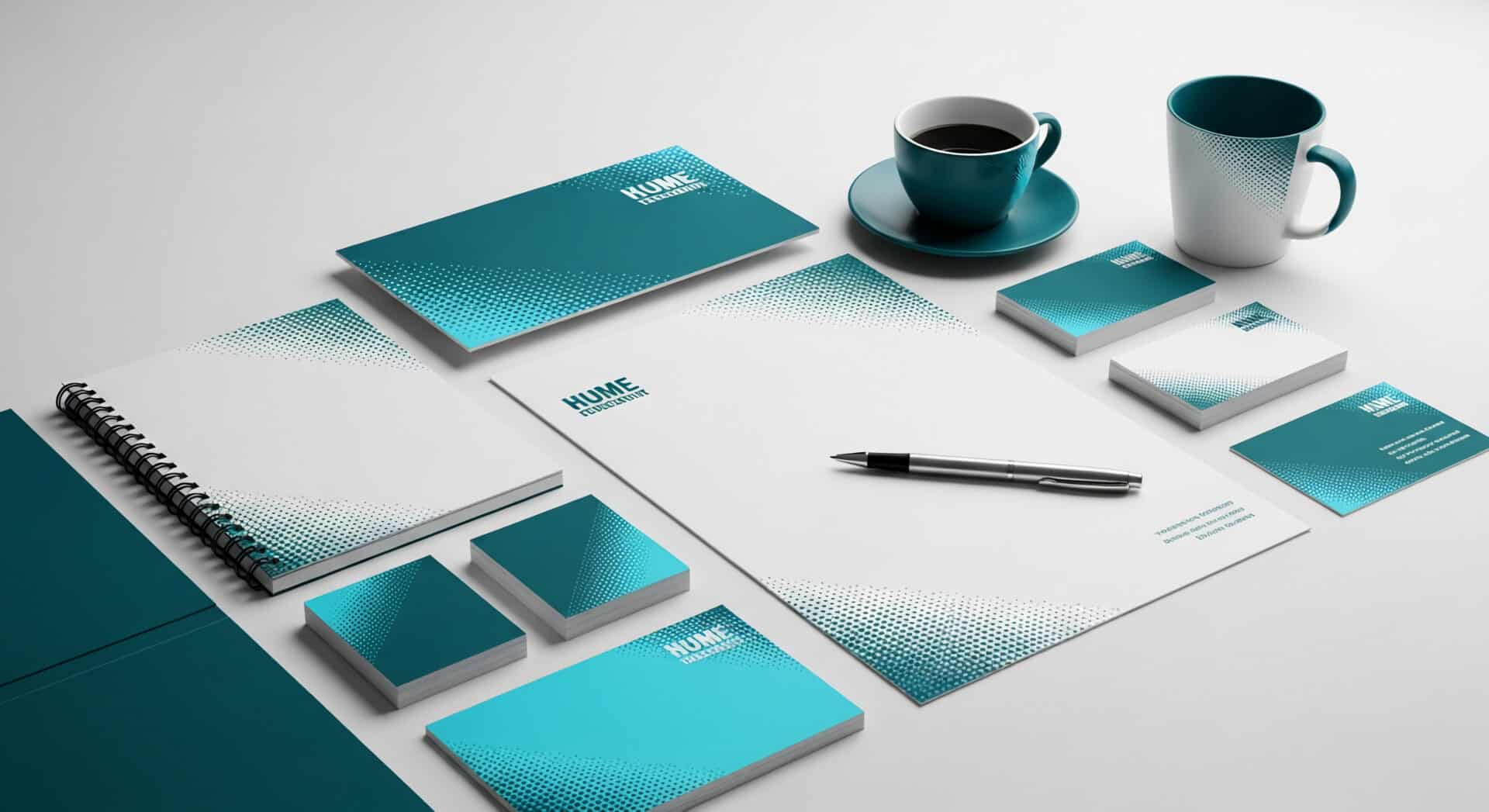
GSM stands for grams per square metre. It tells you how much a given area of paper weighs, which makes it easier to compare stocks for a flyer, letterhead or business card. The right weight depends on what needs to happen to the paper after printing.
Start with how people will use the piece. A sheet that has to fold neatly into an envelope, a card that needs to stand up on a counter and a letterhead going back through an office printer each put different demands on the stock.
What Does GSM Mean When Choosing Paper for Printing?
GSM stands for grams per square metre. It measures the mass of a sheet of paper with an area of one square metre.
For example, a paper described as 100 GSM weighs 100 grams per square metre, while a 300 GSM paper weighs 300 grams over the same area. This measurement provides a consistent way of comparing paper stocks, regardless of the dimensions of the sheet being printed. In paper specifications you may also see it called grammage. ISO’s grammage standard describes how to determine it for paper and board.
A small business card made from 350 GSM stock doesn’t weigh 350 grams. The figure refers to the weight of a full square metre of that material, not the weight of the individual card.
Nevertheless, two papers with identical GSM values can feel different. Fibre composition, surface treatment, manufacturing methods and the amount of compression during production can all influence the finished material.
To estimate the mass of a sheet, multiply its area in square metres by its GSM. An A4 sheet measures 210 × 297 mm, so an 80 GSM sheet is roughly 5 g before printing. At 160 GSM, the same size is roughly 10 g. If you plan to mail several sheets together, treat this as an estimate and weigh a complete test pack with its envelope, inserts and any labels before committing to the run.
If you’re ordering professionally printed materials for the first time, think about the purpose of the item before selecting the weight. A promotional flyer designed for widespread distribution has different requirements from a business card intended to remain in someone’s wallet.
What GSM Should You Choose for Business Cards, Flyers and Stationery?
Different printed products tend to use different paper weights because they serve different purposes.
Standard office documents and correspondence commonly use paper in the region of 80–100 GSM. This is generally suitable for everyday printed sheets, internal documents and many forms.
Letterheads and business stationery often benefit from slightly more substantial paper, with approximately 100–120 GSM being a common starting point. The ideal choice depends on whether the paper needs to pass through an office printer or be written on by hand.
Flyers and leaflets can use a wide range of paper weights. Lightweight stocks may be appropriate for large distributions, while heavier materials can provide a more substantial feel for promotional handouts.
Business cards normally require considerably heavier stock. Papers and cards around 300–400 GSM are common choices, although appropriate specifications vary according to the finish and production method.
For companies ordering business stationery, consistency is important. Letterheads, compliment slips and business cards do not necessarily need identical GSM values, but they should feel like parts of the same professional identity.
Consider how each item will be stored and handled. A flyer that needs folding may benefit from a lighter stock, while a presentation card intended for repeated handling may justify something more substantial.
If a letterhead will go back through your own machine, check its supported paper weights and feed settings. Try a short test run using the intended tray and settings before ordering a large batch. For a small card or appointment slip, test the pen staff actually use and make sure the stock feels sturdy enough once cut to its finished size.
Is Higher GSM Always Better for Professional Printing?
A heavier stock earns its place when it does something the reader or the job needs. A card passed between people at an event may need to hold its shape all day. A notice that stays behind glass has the support of the frame and may need very little stiffness of its own.
A substantial business card can feel impressive, but using similarly heavy stock for a folded leaflet may introduce difficulties with creasing or handling.
Heavy papers can also increase the weight of printed materials being posted or distributed. For a large campaign, that may affect practical costs and storage requirements.
A lightweight paper isn’t necessarily poor quality either. Some printed products are designed to be economical, easy to fold and convenient to distribute. In those circumstances, a carefully selected lower GSM stock may be preferable.
The print design itself also influences how professional the finished item looks. Clear typography, appropriate margins, accurate colour reproduction and suitable image quality all contribute to the result.
Paper should support the design rather than compensate for weaknesses in it.
For example, a straightforward business letter printed on appropriate correspondence paper may look more professional than the same letter on an unnecessarily thick card.
Likewise, a leaflet intended to be folded and placed inside an envelope needs to be convenient to open and read.
The best approach is to balance appearance, usability, budget and production requirements.
Before ordering, ask yourself whether the extra weight provides a meaningful benefit to the person receiving the printed material.
What’s the Difference Between Paper Weight and Paper Thickness?
Paper weight describes mass per unit area. Thickness tells you how much space the sheet takes up.
GSM measures the mass of paper per square metre. Thickness, often called caliper, measures the physical distance between the two surfaces of a sheet.
Paper thickness is commonly expressed in microns, with one micron equal to one-thousandth of a millimetre. The ISO thickness standard distinguishes single-sheet thickness from thickness measured using a pack of sheets.
Two papers with identical GSM values can have different thicknesses because of differences in fibre structure, manufacturing and compression.
Some papers are relatively bulky and feel thick despite having a moderate GSM. Others are denser and feel comparatively thin at the same weight.
This distinction matters when considering how paper will fold, how a stack of printed sheets will fit inside packaging and how a finished item will feel.
For example, two 300 GSM business card stocks may not feel equally rigid. Their surface characteristics and thickness can influence how substantial they seem.
Likewise, paper thickness can affect books, brochures and multi-page documents. A large number of slightly thicker sheets may produce a noticeably bulkier finished document.
If thickness is particularly important, GSM alone won’t provide enough information.
Ask for the paper’s caliper specification or compare physical samples where possible.
This is especially useful when matching an existing printed product or designing something that must fit a particular holder, envelope or presentation folder.
What Are Common Paper GSM Ranges in the UK?
Although there are no universal rules requiring a particular paper weight for each product, commonly used ranges provide a useful starting point.
Paper around 70–100 GSM is frequently associated with general office and document printing.
Approximately 100–170 GSM covers many stationery, leaflet and promotional applications, depending on the desired finish and production method.
Papers around 170–250 GSM can provide a more substantial feel for certain promotional materials, covers and folded printed products.
Card stocks around 250–400 GSM are commonly considered for business cards, invitations and other products requiring greater rigidity.
These ranges overlap because different printers, materials and finishing processes can produce different results.
The numbers should therefore be treated as general guidance rather than fixed specifications.
Paper weight also interacts with surface finish. Coated and uncoated stocks may feel different even where their GSM values are similar, so visual appearance and suitability for writing should be considered alongside weight.
If you are planning flyer printing, bring the finished size, quantity and distribution plan to the conversation. Tell the printer whether staff will hand them out loose, pack them into posted orders or fold them into smaller pieces.
Compare a sample at the final size if you can. A small swatch and a full sheet can feel different in the hand, especially when the sheet has to fold or support its own weight.
Understanding GSM makes it easier to compare paper options and avoid ordering materials that are unnecessarily heavy, difficult to handle or unsuitable for their purpose.
For assistance choosing paper for a particular project, King Print can discuss your printing requirements and help you explore appropriate options.
Take an existing piece you like, if you have one, and explain which features matter. It might be the way a leaflet opens, the weight of a letter in the hand or how stiff a display card feels.